
Quick answer: Framing a finished jigsaw puzzle means bonding it to a rigid support, cutting a mat and a moulding to the puzzle’s measured size, then glazing it. No puzzle lands on a stock frame size. Glue on the face is optional. An adhesive sheet on the back holds every piece flat and leaves the printed surface untouched.
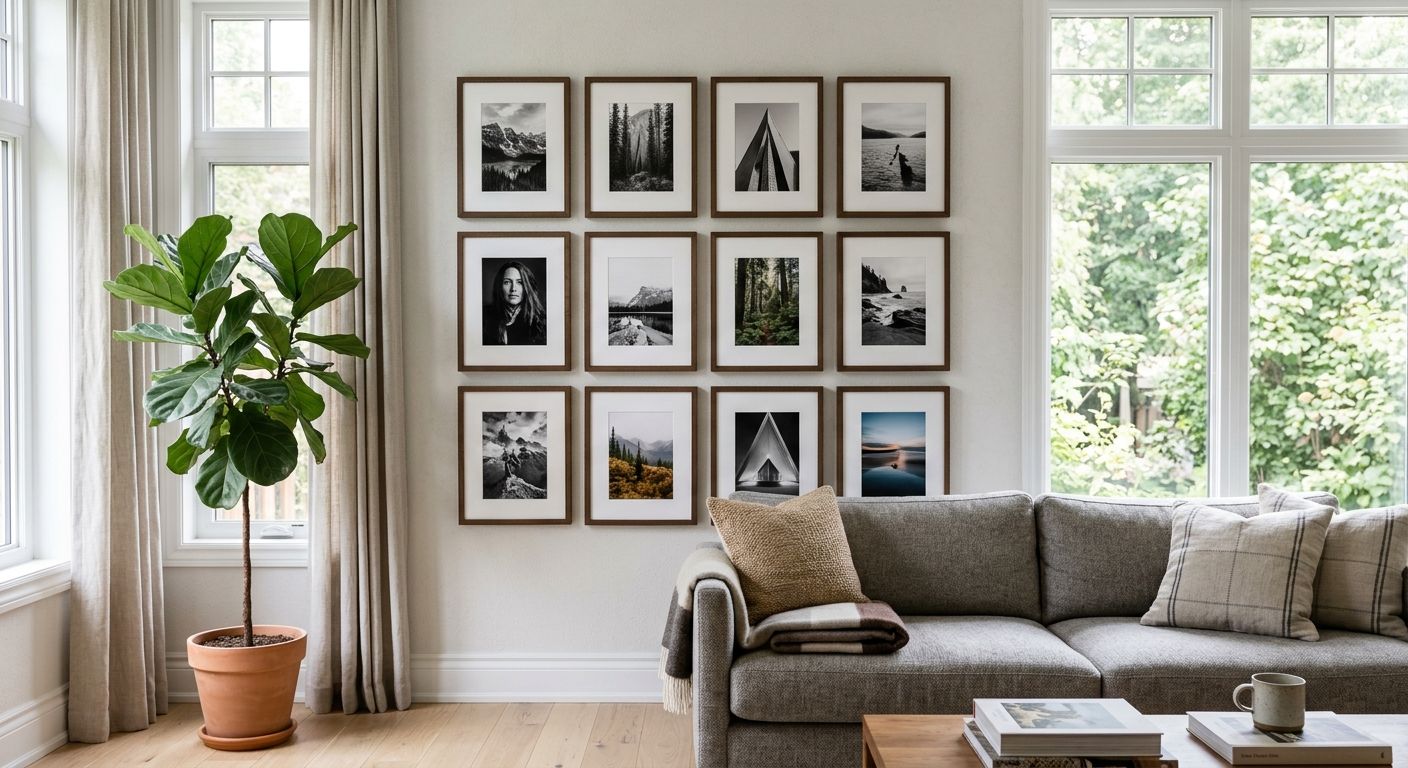
Most puzzles reach us in winter, finished on a dining table the family wants back. Supreme Pictures builds custom frames for pieces like this at 7025 Tomken Rd Unit 4, on Tomken Road near Derry Road in northeast Mississauga, minutes from Malton. Bring the puzzle assembled, and bring the box lid: the artwork on it tells us what colour to pull the mat from.
Should you glue a jigsaw puzzle before framing it?
Three options, and they are not equal. The choice decides whether the puzzle becomes permanent or something you can take apart again in ten years.
Glue on the face. A water based PVA puzzle glue is spread over the assembled puzzle and left flat to cure. It seals the joins from above. It also sits on the ink. The puzzle becomes one sheet forever, the surface carries a sheen, and too much moisture swells the die cut chipboard until it cups.
Adhesive sheet on the back. Flip the puzzle as one piece onto a rigid board, then roll a pressure sensitive sheet onto the reverse. Nothing touches the printed side, and the bond spreads evenly instead of concentrating at the joins. This is what we prefer for a puzzle someone spent forty hours on.
Nothing at all. A small puzzle can sit trapped between a rigid backing and a window mat, with the glazing holding light pressure from the front. It works up to roughly 300 pieces. Past that, gravity finds the weak joins and the middle sags.
| Method | Touches the printed face | Reversible later | Best for | Main risk |
|---|---|---|---|---|
| Face glue (PVA) | Yes | No | Never taking it apart | Sheen, swelling, cupping, glue in the gaps |
| Adhesive sheet on the back | No | Partly, with care | Large or sentimental puzzles | One shot alignment, no repositioning |
| No adhesive, mat pressure | No | Yes | Puzzles under about 300 pieces | Sagging in a large piece |
Dry mounting versus a floated mount
Dry mounting bonds the whole back to a board, with heat and pressure or with an adhesive sheet. Dead flat, and permanent. A floated mount does the opposite: the puzzle sits raised on a hidden support so its irregular outer edge stays visible, with spacers holding the glazing clear. Floating costs depth, and every millimetre of lift is a millimetre the rabbet has to swallow.
If you might want the puzzle back as a puzzle one day, say so before we start. There is no clean way to undo a dry mount.
How do you move a finished puzzle onto a board without breaking it?
Lifting is the moment puzzles die. So never lift it. Slide the support under the puzzle instead.
- Cut the support first. Measure the assembled puzzle and cut a rigid board 25 mm larger on every side. Foam board at 3 mm or 5 mm, or 3 mm hardboard over about 2000 pieces.
- Clear a run. The table has to be flat, dry and longer than the puzzle. Crumbs become bumps under glass.
- Press the whole surface. A flat palm or a soft roller over every square inch. Loose tabs are the ones that pop during the slide.
- Slide a rigid sheet under one edge. A second thin board goes under the leading edge at a shallow angle.
- Advance in short pushes. Ten centimetres at a time, both hands square to the edge. Never twist.
- Support the overhang. Keep the unsupported section flat with your other hand as it crosses onto the new board.
- Square it up. Set the border parallel to the board edges before anything is bonded. Once the adhesive touches, position is final.
- Bond, then weight. Lay a clean board and even weight over the whole area while it sets. Uneven weight makes a wave.
A puzzle that arrives glued and cupped can often be flattened under weight before framing. Bring it in rather than forcing it flat at home.
Why is a puzzle never a standard frame size?
Puzzle makers size a puzzle to fit a box, not a frame. A 1000 piece puzzle is not a fixed dimension. Piece count tells you roughly how big the finished picture will be, and nothing more.
| Pieces | Typical finished size (inches) | Typical finished size (cm) |
|---|---|---|
| 500 | about 14 x 19 to 18 x 24 | about 36 x 48 to 46 x 61 |
| 1000 | about 19 x 27 to 20 x 30 | about 48 x 69 to 51 x 76 |
| 1500 | about 24 x 32 | about 61 x 81 |
| 2000 | about 27 x 38 | about 69 x 97 |
| 3000 | about 32 x 47 | about 81 x 119 |
| 5000 | about 40 x 60 | about 102 x 152 |
Treat that as a planning guide, not a specification. Two 1000 piece puzzles from different brands can differ by 50 mm on the long edge, and the box figure is often a sales figure rather than the assembled one. So we measure the puzzle you built, to the millimetre, with the border pressed flat. Mat window and moulding lengths come off that number.
A window mat is cut with a bevelled opening a few millimetres smaller than the puzzle, so it overlaps the edge and hides the join between puzzle and board. Our custom picture framing service works from measurements, so an odd size costs no more effort than a common one. Ready made picture and photo frames come in fixed sizes and will not fit a jigsaw except by luck.
Board thickness, puzzle depth and the rabbet
The rabbet is the lip on the back of a moulding that holds the contents. Depth matters more with a puzzle than with a print, because the package is thick. Add it up.
- Glazing: 2.5 mm for picture framing glass
- Window mat: about 1.5 mm for 4 ply board
- The puzzle: roughly 2 mm of die cut chipboard
- Mounting support: 3 mm to 5 mm of foam board or hardboard
- Backing board and dust seal: about 1.5 mm
Roughly 10 mm to 13 mm of stack, before a single spacer. Economy polystyrene mouldings often have a rabbet nearer 6 mm to 8 mm, so they will not close. A wood or composite profile with a deeper rabbet solves it, and a shallow rabbet can be extended with a strip behind the moulding. Ask for a written framing quote if you want the number first.
What glazing keeps a framed puzzle from fading?
A jigsaw puzzle is a printed paper image bonded to board. It fades the way any work on paper fades. The Canadian Conservation Institute states that exposure to light causes colours to fade and paper to discolour, natural light and artificial alike, and recommends framing behind glazing that filters ultraviolet light.
Its preventive conservation guidelines for paper objects go further. The target for ultraviolet is no UV at all, with 75 microwatts per lumen or less treated as the practical equivalent of a perfect filter. Visible light gets numbers too. Highly sensitive colours can fade noticeably in 5 weeks to 1 year at 500 lux, and in 20 weeks to 3.5 years at 150 lux. Office lighting sits around 500 lux.
Puzzle inks are commercial process inks on absorbent board, so treat them as sensitive. Three glazing choices matter.
- Regular glass. Clear, cheap, reflective, close to useless against UV.
- Non glare glass. An etched surface scatters reflections, which helps under a ceiling light or opposite a window.
- UV coated glass. The defence CCI describes. Supreme Pictures stocks glass the owner describes as 99% UV coated.
Tru Vue publishes Conservation Reflection Control glass at up to 99% blocking of 300 nm to 380 nm UV rays, total light transmission above 89% and a 2.5 mm thickness, passing the Photographic Activity Test to ISO 18916. A puzzle on a living room wall wants both at once: glare control and UV filtering. Hang it off the wall that catches the afternoon sun, out of a pot light beam, and the glazing handles the rest.
Ask us about framing your finished puzzle
Bring the finished puzzle flat, on a board or a tray, and bring the box lid. We measure it, talk through glue against an adhesive sheet, pull a mat colour from the artwork, and check the rabbet depth. Want the picture on the wall and the pieces back in the box? We photograph the puzzle and print it as a poster instead. Details sit on our custom picture framing page, or send the dimensions through the contact page.
Supreme Pictures
7025 Tomken Rd Unit 4, Mississauga, ON L5S 1R6
Phone: (905) 956-7400
Hours: Monday to Friday 10:30 AM to 7:00 PM; Saturday 10:30 AM to 5:00 PM; Sunday closed
Frequently asked questions
Do you have to glue a jigsaw puzzle before framing it?
No. Glue is one of three options. A pressure sensitive adhesive sheet applied to the back holds the puzzle flat without touching the printed face, and small puzzles under roughly 300 pieces can be held by mat pressure alone. Face glue seals the surface permanently and adds a slight sheen.
What size frame does a 1000 piece puzzle need?
There is no single answer. A 1000 piece puzzle usually finishes somewhere between 19 by 27 inches and 20 by 30 inches, and brands differ by up to 50 millimetres on the long edge. The frame is cut from the assembled puzzle measured with a rule, not from the box.
Can a framed puzzle be taken apart again later?
Only if it was never dry mounted. Face glue and full dry mounting are permanent. A floated mount, or a puzzle held between a backing board and a window mat with no adhesive, can be opened and the pieces recovered. Tell the framer before the mounting method is chosen.
Does framing glass stop a puzzle from fading?
UV filtering glazing slows fading, it does not stop it. The Canadian Conservation Institute advises filtering out all ultraviolet, to 75 microwatts per lumen or less, and limiting visible light too, since sensitive colours can fade within weeks at 500 lux. Position matters as much as the glass.
Why does a puzzle need a deeper frame than a poster?
A puzzle package stacks up. Glazing at 2.5 millimetres, a 4 ply mat at about 1.5 millimetres, roughly 2 millimetres of puzzle board, 3 to 5 millimetres of mounting support and a backing board total 10 to 13 millimetres. Many economy mouldings have a rabbet of only 6 to 8 millimetres.