
Quick answer: An autograph fades because marker ink is dye sitting on the surface of a knit, and light breaks dye apart. Ultraviolet light between 300 and 380 nanometres does most of that damage. Conservation grade glazing blocks at least 97 percent of it. Ordinary picture glass blocks almost none. Mounting and wall placement decide the rest.
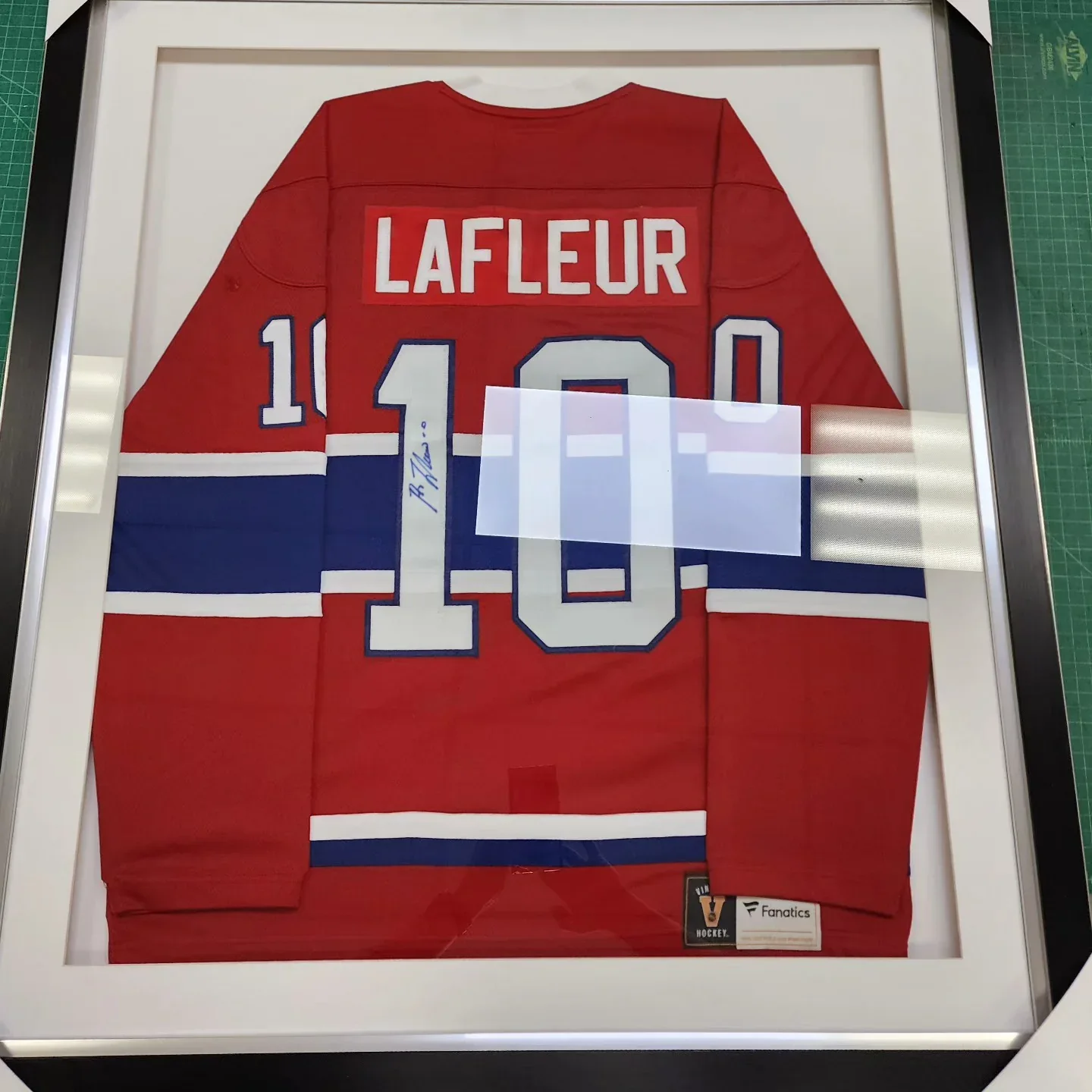
A signature has almost nothing behind it. A screen printed number is pigment pressed into the fabric, so it holds colour for decades. A paint marker leaves a film a few microns deep. When it breaks down there is no reserve underneath, and the line goes grey, then patchy, then gone.
September is when this work picks up. The NFL regular season starts, NHL camps and preseason games open the same month, and jerseys come out of summer storage to become gifts. We frame them at 7025 Tomken Rd Unit 4, near the Tomken and Derry Road intersection in northeast Mississauga, and for customers across Malton and Brampton.
Why do autographs fade on a framed jersey?
Light is energy, and shorter wavelengths carry more of it. The Canadian Conservation Institute states it plainly in its glazing note: clear glass transmits over 90 percent of visible light and cuts only UV below 300 nanometres. The damaging band sits above that. A jersey behind plain glass is, for UV purposes, a jersey on an open wall.
Visible light matters too. The Canadian Conservation Institute’s guidelines for textiles and costumes put display levels for sensitive textiles at 50 lux and medium sensitivity textiles at 150 lux. The same guidance lists office lighting at 500 lux and average daylight at 30,000 lux, and asks that UV be held to 75 microwatts per lumen or less.
A jersey on a wall catching afternoon sun is not sitting at 150 lux. It sits orders of magnitude above, with UV unfiltered. Glazing removes the fastest acting part of the problem.
Three other things attack a signature, and none of them are light. Heat above a fireplace or baseboard heater speeds chemical decay. Humidity below 40 percent makes fibres brittle, above 70 percent it invites mould. And glazing resting on the fabric transfers ink to the glass.
How much UV does conservation glazing actually block?
There is a published bar. Tru Vue’s education page on UV protection in custom framing sets it: glazing must block at least 97 percent of UV in the 300 to 380 nanometre range to count as conservation grade. Below that, it is a marketing claim.
The same page makes the gap concrete. Some glazing blocks roughly 92 percent, premium products up to 99. Tru Vue puts that gap at more than eight times the UV reaching the piece.
Here are the published figures. Watch the transmission column too: dull glazing makes a jersey look dull.
| Glazing | UV blocked, 300 to 380 nm | Light transmission | Reflection |
|---|---|---|---|
| Ordinary framing glass | Only below 300 nm | Over 90% | High |
| Tru Vue Conservation Clear glass | Up to 99% | Over 89% | 8% |
| Tru Vue Museum Glass | Up to 99% | Over 97% | Under 1% |
| Tru Vue Conservation Clear acrylic | Up to 99% | 92% | 8% |
| Tru Vue Optium Museum Acrylic | Up to 99% | Over 98% | Under 1.6% |
UV protection is not what separates a mid range product from a premium one, since both stop up to 99 percent. What you pay more for is optics. Reflection drops from 8 percent to under 1 percent, which on a case across from a window decides whether you see the signature or yourself.
Supreme Pictures stocks regular glass, non glare glass, and UV coated glass the owner describes as 99 percent UV coated. A jersey already framed behind plain glass does not need rebuilding. Swapping the glazing is a straightforward job on our frame repairs bench, and the highest value single change to an existing case.
Glass or acrylic for a large signed jersey case?
Protection is not the trade off. Both materials reach up to 99 percent UV blocking. Size and weight decide it.
A jersey case is big. A framed adult hockey jersey usually finishes around 30 by 38 inches, and a deep box adds moulding weight on top. Glass at that size is heavy, and dangerous if it comes off a wall above a couch. Acrylic weighs half as much and does not shatter.
Acrylic has two drawbacks. The Canadian Conservation Institute notes large plastic sheets must be 3 mm thick to avoid bowing, or they belly inward and touch the fabric. Plastic also holds an electrostatic charge, ruling it out over pastel or flaking surfaces.
Pick this way:
- Under about 24 by 30 inches, at eye level, nothing underneath: conservation glass, which scratches less.
- Larger, hung high, or in a basement games room: acrylic at 3 mm or thicker.
- Over a stairwell, a bar or a crib: acrylic, without discussion.
The rabbet, the lip on the back of the moulding, has to swallow glazing, spacers, the jersey and the backing board. Our custom picture framing service covers that.
How do you mount a signed jersey without damaging it?
By sewing it, into a board it can be unsewn from. The Canadian Conservation Institute’s guidance on framing embroideries and flat textiles is direct: textiles should be mounted onto a fabric covered solid support before framing, because that method is easily reversed without damaging the textile. It rules out glues, adhesive tapes, staples, tacks and nails in contact with the object.
Reversibility matters. If the piece is ever authenticated, sold or reframed, it has to come out in the condition it went in. Glue makes that impossible. Pins rust and tear.
Here is the sequence.
- Cut a rigid acid free support sized to the frame, with no lignin bearing cardboard in the package.
- Cover the board in prewashed, colourfast cotton, usually a team colour so the jersey reads against it.
- Make up the jersey on the board. Shoulders square, number centred, sleeve folded the way it will stay. Weight bags hold it, and nothing pierces the knit yet.
- Stitch through the knit into the covered board with a fine curved needle and colourfast thread. Stitches go where the weight is: shoulder seams, sleeve fold, hem, collar.
- Keep every stitch off the signature. Thread crossing an autograph is visible and abrasive.
- Hold the glazing off the fabric with spacers, or enough box depth that nothing touches, so raised areas are not crushed flat.
- Seal the back against dust and insects, then fit hanging hardware rated for the finished weight.
How deep does the shadow box need to be?
Depth gets measured on the made up jersey, not chosen from a catalogue. Lay the piece out as it will be framed, measure the highest point above the board, then add clearance so the glazing never touches the fabric.
| What goes in the box | Highest point to clear | Typical inside depth |
|---|---|---|
| Jersey mounted flat, no fold | Collar and shoulder patches | About 3/4 inch |
| Jersey with one sleeve folded | Two knit thicknesses at the fold | 1 1/2 to 2 inches |
| Jersey plus a signed puck | A puck is 1 inch thick | 2 to 2 1/2 inches |
| Jersey, sleeve fold and a ticket | The fold plus the mount | About 2 inches |
Deeper is not safer. A box 3 inches deep for a 1 inch object throws a heavy internal shadow. Our shadow box framing page applies the same logic to other objects.
Where the case hangs decides how long the signature lasts
Glazing buys time. Placement decides how much of it you spend. Run through this before you drive a hook into the wall.
- Never on a wall the sun reaches. Not facing a window, and not opposite a west facing one. Average daylight runs at 30,000 lux.
- Never above a heat source. Fireplace, radiator, baseboard heater or a warm media unit.
- Never in a bathroom, an unheated garage or against an uninsulated basement wall.
- No picture light bolted to the frame. Frame mounted fixtures produce excessive light in one small spot.
- Interior walls and hallways win. Low ambient light, stable temperature, nobody brushing past the glazing.
- Check the reading. A phone light meter app is not laboratory grade, but it says whether a wall sits nearer 150 lux or 1,500.
If the only wall you love is the sunny one, add a blind or UV film on the window as well. Two barriers, because otherwise one does all the work.
Get a signed jersey framed properly in Mississauga
Bring the jersey, plus any puck, ball, ticket or photo with it, and a rough idea of the wall it is headed for. We lay it out, measure depth on the object, and match glazing to where it will hang. Details sit on our jersey and memorabilia framing page, or send measurements through the quote form.
Supreme Pictures
7025 Tomken Rd Unit 4, Mississauga, ON L5S 1R6
Phone: (905) 956-7400
Hours: Monday to Friday 10:30 AM to 7:00 PM; Saturday 10:30 AM to 5:00 PM; Sunday closed
Frequently asked questions
Does UV glass stop a signed jersey from fading completely?
No. Conservation grade glazing blocks at least 97 percent of UV in the 300 to 380 nanometre range, and premium glass and acrylic reach up to 99 percent. Visible light still causes fading. Glazing slows the fastest part of the damage, and wall placement away from sun and heat handles the rest.
Is acrylic as good as glass for protecting an autograph?
Yes, on UV. Tru Vue publishes up to 99 percent UV blocking for both its conservation glass and its conservation acrylic. Acrylic weighs about half as much and will not shatter, which matters on a large case. It needs to be 3 mm or thicker at big sizes to avoid bowing.
Should a signed jersey be glued or pinned to the backing board?
Neither. The Canadian Conservation Institute advises mounting textiles onto a fabric covered solid support, a method that reverses without damaging the piece, and rules out glues, adhesive tapes, staples, tacks and nails. A jersey should be stitched with colourfast thread through the knit into the covered board.
How deep does a shadow box need to be for a jersey?
Depth is measured on the made up jersey. A flat mounted jersey needs about 3/4 inch inside the box. One folded sleeve pushes that to roughly 1 1/2 to 2 inches. Adding a signed puck takes it to about 2 1/2 inches, since a puck is 1 inch thick.
Where should a framed jersey hang in a room?
On an interior wall that no direct sunlight reaches, away from any fireplace, radiator or heat vent, and out of bathrooms and unheated garages. Average daylight measures around 30,000 lux against a 150 lux display level for medium sensitivity textiles. Skip picture lights mounted on the frame.