
Quick answer: A baby passport photo in Canada uses the same specification as an adult one: 50 mm wide by 70 mm high, with the face measuring 31 mm to 36 mm from chin to crown. IRCC makes one allowance for infants. Newborns may have a range of facial expressions. The photo must still be taken by a commercial photographer or studio.
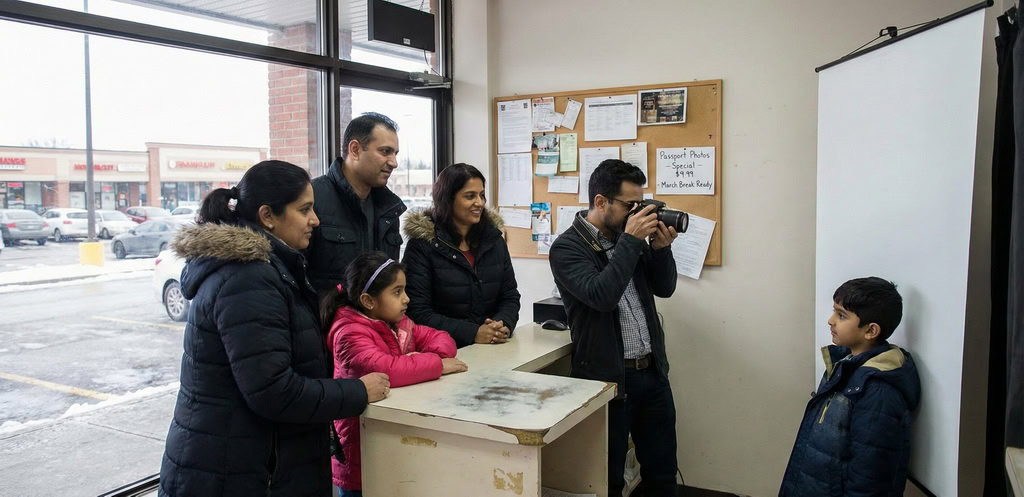
That last sentence is where most parents get caught. A phone photo against the nursery wall is not eligible, no matter how sharp it looks. Supreme Pictures can shoot infant passport photos at 7025 Tomken Rd Unit 4, a short drive from the Tomken and Derry Road intersection in northeast Mississauga. Two prints cost $9.99.
What does IRCC require for a baby passport photo?
The Government of Canada passport photo specification does not publish a separate size chart for children. One chart covers everyone. The only written concession for the very young is the expression rule.
| Requirement | IRCC specification | What changes for a baby |
|---|---|---|
| Printed size | 50 mm wide by 70 mm high (2 inches by 2 3/4 inches) | No change |
| Face height, chin to crown | 31 mm to 36 mm (1 1/4 to 1 7/16 inches) | No change. Measured on the baby’s face, so a small head has to be framed tighter |
| Background | Plain white or light coloured | No change. A white sheet counts, a patterned blanket does not |
| Who takes it | In person, by a commercial photographer or photo studio | No change. This is the rule home photos fail |
| Printing | Professionally printed on plain, high quality photographic paper | Photos printed at home or on heavyweight paper are not accepted |
| Expression | Eyes open, looking at the camera, mouth closed, no smiling or frowning | Relaxed. IRCC states newborns may have a range of facial expressions |
| Lighting | Uniform, no shadows, glare or flash reflections | Harder. A parent leaning over the baby throws a shadow |
| Age of photo | Taken no more than 6 months before you submit | No change, and infants change fast |
| Editing | Original, not altered or edited in any way | Filters and AI tools cause rejection |
| Quantity | 2 identical photos | No change |
| Back of one photo | Studio name, complete address, date taken | No change |
Read the expression line carefully. IRCC relaxes the neutral face rule for newborns. It does not relax the eyes rule, the background rule, the shadow rule or the measurement. Those four are where infant photos actually get returned.
The face height problem nobody warns you about
A newborn head is small. To put 31 mm to 36 mm of face inside a 70 mm tall print, the camera has to be close and the crop has to be tight. Shoot from across the room, crop later, and you lose resolution. The print then goes soft and the edge of the face blurs into the background. That is a technical problem, not a parenting problem. It is solved with correct lens distance and a proper photographic print, which is exactly what the commercial studio rule exists to enforce.
How do you photograph a newborn who cannot sit up?
There is one reliable method for a baby under about six months. Lay them down and shoot straight down.
- Lay the baby on their back on a plain white sheet. Smooth it first. A wrinkle reads as a shadow line behind the head.
- Shoot from directly overhead, square to the face, so the camera sits parallel to the sheet. An angled shot skews the chin to crown measurement.
- Clear the frame completely. No hands supporting the head. No soother, no toy, no bottle, no blanket edge, no car seat strap, no sleeve. If it is in the frame, it is a rejection.
- Keep the light to the side and diffused. Overhead lighting plus a person leaning in equals a shadow across the face.
- Watch what the parent is wearing. A dark shirt hanging into the top of the frame ruins an otherwise clean shot.
- Time the visit. After a feed and before a nap is the window. A hungry baby will not open their eyes, and a sleeping one will not either.
- Take many frames. Eyes open and clearly visible is still the standard. We shoot until we have it.
For an older infant who can sit but cannot hold a pose, a car seat draped in a plain white sheet works better than a parent’s lap. The seat holds the head upright, the sheet gives the plain background, and no adult hands appear in the frame.
Eyes open, or as close as you can get
IRCC asks that eyes be open and clearly visible. With a sleeping newborn that is not always achievable in one sitting. The practical approach is simple. Book at a time of day your baby is usually alert, bring a second adult to draw attention from behind the photographer, and accept that this may take twenty minutes rather than two.
Why do phone photos of babies taken at home usually fail?
Because they fail on rules that have nothing to do with image quality. A parent can take a technically lovely photo and still have the application returned. Here is the failure list in the order we see it.
- The commercial studio rule. The photo must be taken in person by a commercial photographer or photo studio. A home phone photo does not qualify.
- The printing rule. IRCC does not accept photos printed at home or on heavyweight paper.
- The back of the photo. The photographer writes or stamps the studio name, the complete address and the date the photo was taken on the back of one print. A home print has no studio name and no address, so the application is incomplete before anyone looks at the face.
- Background contamination. Nursery walls are rarely plain white and rarely evenly lit. Patterned bedding is an automatic fail.
- Shadows. Ceiling lights plus an adult standing over the crib produce a shadow under the chin every time.
- Editing. Phone cameras apply skin smoothing and colour processing by default. IRCC requires an original photo that is not altered or edited in any way, and names photo editing software, filters and AI tools specifically.
- Wrong proportions. Cropping a phone photo to 50 by 70 almost never lands the face inside the 31 mm to 36 mm band.
If you want the full adult version of these specifications, our Canadian passport photo requirements guide covers the complete list. For pricing on other photo print sizes, see our photo printing in Mississauga page.
What does the rest of a child passport application need?
The photo is one piece. Three child-specific rules catch parents out, and all three come from the IRCC child passport page.
A child passport is valid for a maximum of 5 years. It stays valid until its expiry date, even after the child turns 16.
You cannot renew a child passport. When the child turns 16 they apply for a new adult passport, a fresh application with fresh photos.
Never sign the passport for your child. It does not need a signature until they are 16 or older.
The guarantor rule for a child
A child application needs a guarantor, and the requirement is stricter than people expect. Under the IRCC guarantor rules, the guarantor must have known you for at least 2 years and must know of your child. They must be a Canadian citizen 18 years of age or older. They must hold a 5 year or 10 year Canadian passport that is valid, or expired by no more than one year, on the day you submit.
The guarantor writes on the back of one photo: I certify this to be a true likeness of, followed by your child’s name, and signs beneath it.
That means one of your two identical prints carries three separate things on its back. Our studio name and complete address. The date the photo was taken. The guarantor’s certification and signature. Keep the second print clean. Do not let anyone write on both.
Not the same as a citizenship or visa photo
Citizenship photos and passport photos are different specifications, and IRCC says so in plain words on its own citizenship page. If you are applying for a child’s citizenship certificate rather than a passport, start from our citizenship photo page instead, and tell us which application you are filing before we shoot.
Book a baby passport photo in Mississauga
Bring the baby, a plain sleeper or a light top, and a rough idea of when they are usually alert. We handle the sheet, the lighting, the measurement, the crop and the back of the print. Two identical prints, $9.99, sized to the IRCC specification.
Full details sit on our passport photo service page, or ask us anything through the contact page.
Supreme Pictures
7025 Tomken Rd Unit 4, Mississauga, ON L5S 1R6
Phone: (905) 956-7400
Hours: Monday to Friday 10:30 AM to 7:00 PM; Saturday 10:30 AM to 5:00 PM; Sunday closed
Frequently asked questions
Does a newborn need their eyes open in a Canadian passport photo?
IRCC asks that eyes be open and clearly visible in every passport photo, including a newborn’s. The rule it relaxes for newborns is expression: babies may show a range of facial expressions rather than a neutral face. Book at a time your baby is usually alert and expect several attempts.
Can I take my baby’s passport photo at home with my phone?
No. IRCC requires the photo to be taken in person by a commercial photographer or photo studio, and professionally printed on plain, high quality photographic paper. Photos printed at home are not accepted. A home print also lacks the studio name, address and date required on the back.
How long is a Canadian child passport valid?
A child passport is valid for a maximum of 5 years and stays valid until its expiry date, even after the child turns 16. You cannot renew a child passport. When the child turns 16, they apply for a new adult passport with new photos.
Who can be the guarantor on my child’s passport application?
Your guarantor must be a Canadian citizen aged 18 or older who has known you personally for at least 2 years and knows of your child. They must hold a valid 5 year or 10 year Canadian passport, or one expired by no more than a year.
How many passport photos does a baby need, and what goes on the back?
Two identical printed photos. The back of one carries three things: the photo studio’s name and complete address, the date the photo was taken, and the guarantor’s line certifying it is a true likeness of your child, followed by their signature. Leave the second photo unmarked.